Friday, 13 February 2015

Across Canada by Train - its all about the journey


I love train travel.  I always have.  On my journeys I always get more excited than most if I here there is potential to take a train journey.  Particularly the ones where overnight travel is required.  There's something special about going to sleep to the noise of the train whirling along the tracks and then waking up to the same soothing noise.  That's not to say all my journeys have been great, but you're always sure of an adventure and to see some things that most people don't see when you step through the door into the carriage.  The journey across Canada was no different.  I had been to Canada before and this time persuaded my travelling companions that in order to see as much as possible whilst we were here, there was no alternative but to take the train. 

Train station - a place of exciting possibilities 
Our journey started in Winnipeg, a strange kind of place.  A friendly enough city, but flat, very flat and located in the middle of Canada, just 20km from the longitudinal centre.  After a few days here we were going west all the way to Prince Rupert on the Pacific coast.  It was to be a journey in stages.  We were going to hop on and off the train stopping at various points from Jasper to Prince George.  We had chosen to go with VIA Rail, rejecting the trains meant for tourists and instead taking the everyday train.  This meant we could go on whichever sections of the journey we wanted and save a considerable amount of money. 

Viewing the never ending prairies
The first journey was long we got on the train midday-ish in Winnipeg and settled into our reclining seats.  Large and comfy and facing each other, this would do nicely.  A far cry from the long distance trains I had been used to.  As the train moved along, we couldn't help be surprised by the view out of the window.  I had expected more, instead we were confronted with mile after mile of flat prairie country.  As we passed through Saskatchewan it continued the plains only dotted with farms and grain elevators.  As we settled down to get some sleep the endless prairies continued.  We woke at 6ish.  Outside the windows more of the same. 

 
The trains we travelled on all had a viewing carriage available to all and the glass domed roof was an opportunity to be surrounded by sky and as we approached, mountains.  As we travelled further west the view became more interesting.  The train moved through landscapes of lakes, bridges crossing clear blue rivers, lakes by the side of the track and even glaciers high in the Rockies.  Snow capped peaks brought people into the viewing carriage and the talk of bear sightings more still.  The  bears were proving elusive, a tiny glimpse of one as the train passed quickly by meant everyone now knew what they were missing.  But bears aside interesting villages and small settlements, totem poles and farms had us wondering who lived in these isolated settlement and just what there was to do here.
 

At one point the train stopped, it was going to be a while.  A goods train was coming the other way, there was no choice but to wait for it to pass.  We spent the time buying ice creams from the local stores and laying coins on the track ready to be flatten by the goods train.  We counted the carriages until the train had passed, losing track half way as it went on and on.  Trucks piled high with raw materials and commodities going back east.  Picking up the suitably flattened coins we were back on the train and the journey continued west.  As we approached Prince Rupert we were both a little sad that it was the end of the train trip but also excited for the inside passage trip that was to come.  It was the end of the country, as the Pacific came to meet us and mountains rose up around the town, it seemed a suitable destination to stop, the town both having the feel of not much to do but also a place that exists here because of the train.

 
As we boarded the ferry the next day and turned south, it was a little disappointing that Alaska only 40 miles away was to remain out of reach for now.  But with more trains on offer, a return trip is definitely not out of the question.


Sunday, 8 February 2015

Grazing in Madrid


By the time we got back home I needed to rest my stomach.  A city break in Madrid had turned into an opportunity to spend a lot of time grazing.  We hadn't planned it liked that.  We had thought we would be busy with museums, art galleries and culture, and in many respects we were.  But wandering around the city of Madrid also meant taking in wonderful smells and tempting sights of delicious treats that seemed to be available in many locations.  It all started on day one.  We arrived late in the evening and having had a long day we decided to try and find something to eat locally. 
 
The guidebook had promised lots of small bars and tapas in all locations.  However this did not seem to be the case in the area we were staying.  Not wanting to walk far we tried one restaurant that was full even at 10 o'clock at night.  Undeterred we wandered further into a housing estate and found a small bar open.  It wasn't a particularly appealing looking place, Formica tables and high stools at the bar.  However we spied cold beer on tap and delicious looking Iberian ham on the counter and were drawn in.  We tried to order some food.  Tricky without any Spanish.  In the end the waiter just brought us stuff.  And every time we ordered more beer he brought more food.  A good system.  We feasted on various morsels and enjoyed every minute of time in this locals bar.

 
Another destination of choice for further grazing was the Mercado de San Miguel located in the city centre.  This old market has been renovated and now provides countless counter bars where individual taps are prepared.  Seating is limited but not the food and drink.  It's difficult to decide where to start but having arranged to meet back in 10 minutes off we went.  Fish, meats, cheeses and breads, paella and foie gras all on offer for between 1 and 5 Euros.  Piling plates high we met at one of the bars.  A huge piece of wood, smooth and worn, either with age or the number of elbows on it.  Behind it bottles of all sizes stacked up ready for the demand.  Rioja in large glassed flowed and as the place became busier the noise and hustle and bustle grew as the place filled up with both tourists and locals alike.

Rioja Madrid style
Whilst on the theme, other food destinations of choice included the Mercado de San Anton where fresh fruit, vegetables and fish were all displayed in a colourful and eye catching way, and the Iberian ham marquee that just happened to be in the Plaza Mayor while we were there.  Who knew Madrid has the second largest fish market in the world after Tokyo?


Madrid provided many treats and not just of the edible kind, the vast museums of treasures, huge parks and cobblestone streets all are well worth the visit and might feature another time.  But for now the chocolate con churros stand out.  We had resisted for 4 days but on our final night in the city we gave it a go.  Rude not too.  The famous destination of local choice was Chocolatria de san Gines where we ordered 2 portions of these donuts with chocolate sauce.  It proved hard work.  The initial effort soon petered out and defeat was upon us, this trip had taken its toll on our stomachs.  If only we had come here earlier in the week!!


Monday, 2 February 2015

Hiroshima - a city that's moved on...?


We had wanted to go to Hiroshima since arriving in Japan 2 months before.  Finally we made it happen, as one of the people we had got to know decided that he and his girlfriend would drive us the 5 hours it took to get there.  Never one to look a gift horse in the mouth, we took them up on their kindness and found ourselves arriving at lunch time the following day. 

 
The only thing we really knew about Hiroshima was I guess the same as every school child now knows.  That it was the site of the first use of the atomic bomb in conflict, which had such a devastating impact on the city.  As we drove in we didn't know what to expect but I guess not what appeared before us.  High rise modern buildings, traffic queues and people hurrying about their daily routine, and on the outskirts leafy tree lined avenues.  Hardly surprising as it was a long time after its infamous past. 
Down town, and city like many others
The city itself was hard to like.  However certain bits really stood out, and have stayed with me for a long time.  Not least the delicious food that was served up.  By this time I had become a fan of 'okonomiyaki' and this cities didn't disappoint.  We filled up on the tasty cabbage based snack, (yes really) in a busy train station restaurant, where we watched our food be created before us, before being served up steaming.  This place was busy, people coming and going  grabbing a seat at the bar counter, consuming and then moving on.  We did the same, we had places on our agenda that had to be seen.

Okonomiyaki - delicious
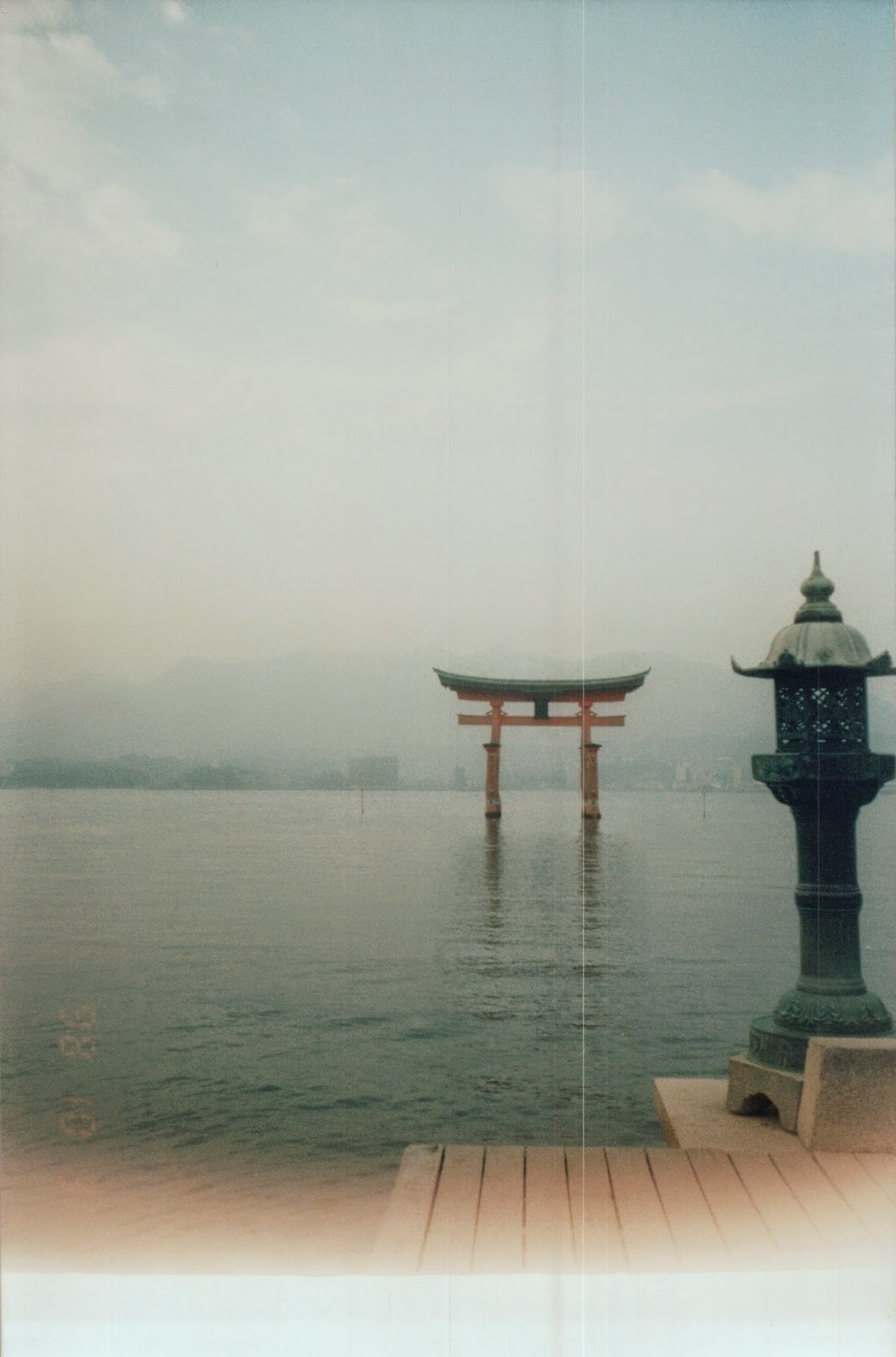
The first I can still see.  The perfect view of Miyajima island with its famous red Torri shrine that seems to float on the water.  To get to the island we crossed on the car ferry, a smooth 15 minute trip.  It was fairly quiet at this time, maybe because even in October there was a chill in the air.  Off on the Island we had time to take in the view of the shrine itself, it creating an extremely pretty view with mountains in the background.  The water itself was remarkably clear and looked inviting.  Paddling however seemed a bit wrong in this sacred spot so temptation resisted, we looked around the temple and museum instead.   After admiring the traditional roofs and red woodwork of these traditional buildings we headed up the hill to check out the pagoda which was restored in 1533 and shows both examples of Chinese and Japanese influences.  It was well worth the hill for the views back to the mainland alone.

Miyajima
The following day we got up early, caught a bus and walked a while through the streets of downtown Hiroshima, past the castle and towards the second destination and reason for this trip.  In front of us stood Genbaku dome (A- bomb dome), the legacy of the bomb that struck the city on 6th August 1945.  Despite some opposition from city residents this building at the hypocentre of the bomb blast remains standing as a memorial to all the people that were killed.  It looked odd here, out of place, which I guess was the point, a sign of destruction in this now modern metropolis.  We walked further and entered the peace park.  A large green leafy area that now provides a place of contemplation, and remembrance for all who visit.  Located here is the 'eternal flame' which will not be extinguished until the last nuclear bomb on earth is destroyed.  A vain hope but a powerful one.  For all the people who feel that nuclear war is acceptable a visit to the museum on site will change even the strongest of views.  Its well done, being both informative and emotive at the same time, telling stories of individuals lost and sorrow lived through. But even as we left the museum we were stuck with the message of this place, that although remembering the past was clearly important it was the message for the future that stood out.  A message that clearly spoke of concern that events like this might not be a thing of the past but a real worry for the future.

Genbaku dome, a memorial of the past
Leaving Hiroshima on the train we had much to think about, the 2 sites we had visited reflected this cities past whilst at the same time expressed hope for its future.

Monday, 26 January 2015

Malaysian Borneo - Its all about the animals


It was a surprise visit organised by the company I was working for at the time.  And as I stood in the middle of the Sepilok forest reserve I felt privileged to be there, orang-utans were swinging through the trees making their way into a slight clearing in the forest where lunch was waiting.  These orang-utans were the lucky ones, after a poor start to their lives, these orphans had been brought to this sanctuary to be rehabilitated.  Care is provided for those that need it, medical help given if necessary, but also important is the life skills these creatures receive as they learn to look after and feed themselves.

The gathering crowd
 
The orang-utans that came swinging in to land on the feeding platforms were those that hadn't quite decided it was time for them to leave yet, they are offered the security of a good lunch if they want it, before they disappear off into the forest reserve.  Sometimes seen regularly sometimes not seen for days. 
Checking us out
We had followed a guide and the board walk to get to the place where a viewing platform allowed us free view of the orang-utans having fun.  They were eating and swinging on the ropes that had been strung up between the trees.  They particularly seemed to enjoy hanging holding on with a mixture of 2 or 4 grips.  A lot of bananas were consumed in the time we spent there.  It was quiet in the forest apart from the noise of birds and of the breeze in the trees, a perfectly great spot to watch these creatures at work.
What a feast!
The second of the wildlife adventures experienced on that trip was accessed by boat.  The Turtle Island of Borneo is located in the Sulu sea, just off the north coast of Borneo.  We didn't know what to expect but as our small boat pulled off the jetty and made its way towards the small island in front of us the excitement grew.  We were only going to be there for one night and the afternoon was spent exploring the accommodation area of the island and waiting for nightfall.  For it was then that we would appreciate why we had come here. 

Getting the boat from the mainland

The island is one of the worlds' most important conservation programmes in order to ensure the survival of the sea turtle.  Turtles come upon the beaches of this island to lay their eggs.  And that night we were lucky enough to see, with the help of our guide some turtles settling in for some egg laying.  It took a while, but it was amazing watching in the darkness, the faint light from the moon highlighting areas of the beach.  What a privilege.  The eggs of the turtles are later uncovered and collected by the rangers that work on the island.  They are kept in a hatchery for up to 60 days, this protects the eggs from hunters and natural predators. After the turtles hatch they are then released back into the sea.  They were very cute, and I have to say very many.  The turtles here lay eggs all year round, so you are pretty much guaranteed to see some on a visit to this special island.

Turtle Island
So Malaysian Borneo, a place with much to offer, covered here is only 2 of the many highlights.  But there is a worry.  The growth in the demand for palm oil combined with the poverty of many people in this area, is resulting in large scale deforestation of some of the most unique environments on the planet.  I just hope other solutions to this large scale destruction are found before it's too late for the orang-utans, and before we come to realise just what we have lost.


Monday, 19 January 2015

Essaouira, Morocco - riads, fish and goats


Definitely a place well worth visiting in Morocco in the ancient port town of Essaouira.  Ignore the modern hotels springing up along the sea front further out of town where the beaches are and instead head down to the port itself.  Bright colourful fishing boats with vivid blues, yellows and reds are lined up unloading today's catch.  This is where all the action is in this town, as people hustle to the sea front to watch the boats off load.  Fish is rapidly sent off to market and no one really seemed to mind me standing around taking pictures.  There is a real atmosphere about the place as a whole.  Much smaller than Marrakesh but with a similar level of energy at certain times of day.
Fishing Boats in port
Leaving the port area we wondered around the back streets of this town.  Cobbled alleyways leading to dead ends and other dark passage ways before opening up into large streets.  Merchants peddled their wares from shop fronts and stalls that had sprung up along the sides of the roads.  Some sold every day hardware and food stuffs and many beautifully dressed Berber ladies were going about their daily shop, choosing fresh fruit and vegetables with deep consideration.  Others sold leather goods and fine silk scarves, bright colours and patterns inviting you to buy more than you need.  In the medina crowds bustled particularly in the evening and late afternoon, when temperatures fell to a more manageable and less uncomfortable level, and seemed to bring out whole families to enjoy just wandering around. 
 
The front of the town is protected by sea walls and ancient defences, where canons still line the barricade.  A good walk was had along these taking in the sweeping views out to sea.  Even if the wind was a bit wild it made great waves crashing onto the rocks that lined the base of the defences.


The historic riad we were staying in was larger than others we had seen, and had, so the story told been a destination of Jimi Hendrix at one point.  A courtyard in the centre was complete with intricately carved designs and colourful tiles, as well as a fountain that continuously trickled.  The rooms themselves more unusual, with solid stone bath and terracotta colouring.  Views from the roof terrace were of the other rooftops of the town, all whitewashed to reflect the heat.  And if we strained we could see more of the hustle on the streets below, where the smells of meat on a stick floated up to tempt us, and made it easy to choose our destination for dinner.

Goats and Argan trees
 
Worth mentioning on the journey here by, who can be only described as slowest driver in the world, was the strange sight of goats up trees.  These goats had a taste for the fruit of the Argan tree, helpfully giving the local Berber people a hand by climbing the tree, eating the fruit and dropping the Argan seeds to the ground, where they can be collected to make all sorts of oil based products. 

 
Essaouira is definitely a place where it is easy to stay. 


Monday, 12 January 2015

Georgia - Mother Georgia and Stalin

Tbilisi capital of Georgia.  A city we were keen to get to and spend some time looking around.  The guidebook promised much, interesting museums, theatres and winding lanes in the old town just waiting to be explored.  Arriving at night was interesting.  It was easy to find somewhere to stay, exiting the tube and checking into one of the many hotels on offer opposite the station.  Bags dropped it was a short walk down hill where a brightly lit vista awaited us.  A new cable car spans across the city, crossing over the river that spits the city in two and rises up to the Nariqala fortress overlooking the city.  Even late at night the park by the river was full of people.  Families enjoying the fountains dancing in time with the music, and the wares the sellers offered, iced coffee, candy floss and a variety of items that could be launched in the air and if you're not careful never seen again.  From the park a new bridge crossed the river, and sparkled in twinkling lights in a manner that seemed at odds with the rest of the old city that we explored the following day.

Cable car over Tbilisi
The city was smallish, mostly walkable, although the tube was easy to use.  However clearly August was not the best time to visit as those museum and theatres that sounded so promising were mostly shut for holidays or being refurbished.  The puppet show at the famous Rustaveli theatre was also a no go, so instead time was spent just wandering.  There was a certain buzz about the city, it had a youthful vibe, with expensive new bars and restaurants spring up in the tourist trap part of town.  These were full of locals not tourists. 

Are they?
Other highlights of this city included the obligatory large statue as found in all ex soviet states, this time 'mother Georgia'.  This 20 metre high aluminium women is easily reached by cable car, and from her feet are good views of the city beneath.  A different monument of sorts is the huge Tsminda Sameba Cathedral that was only consecrated in 2004.  Well worth a look, in a period that see Christianity on the decline in the UK, it's interesting to see the popularity of this post soviet religious revival taking place in Georgia. 

Tsminda Sameba Cathedral
With activities on the verge of exhaustion in Tbilisi itself, a trip to Gori was decided upon.  This town small and relatively poor by Georgian standards, has one claim to fame, and that was Stalin was born here.  You can visit his house, and the train he used to travel whilst ruler of the largest country on earth.  It's interesting.  There is also a very sizeable museum, dedicated to Stalin's rise to power and some of the key members of the communist party.  There were few visitors but our guide was very informative and explained the museum was a museum in itself, explaining the power of the USSR and its propaganda steam roller, whilst ignoring some of the less 'favourable' parts of history.  Am not sure how true this was, but certainly the museum looks exactly how you would have imagined it during Soviet occupation, even if Stalin himself died before it was opened.  Just how long it remains open for remains to be seen.

Stalin - Travelling in style
Also in this town are the remains of a fortress.  This is nothing special in itself, but at the foot of the hill on which its built are some strangely eerie looking metal warriors each with bits missing.  These were built as a memorial to those lost in the 2008 war over South Ossetia, when Russia bombed Gori.

Restless warriors
After all this history it was time for a break.  Sitting in the abandoned square with only the surrounding architecture evidence of its former glory, we decided that this place was weird.  That's not to say we didn't like it, just it felt a bit sad, its glory days over, and that's 'glory' in the strange sense of the word.  We decided it was time to head back to Tbilisi and have another go on the cable car.

 
Mother Georgia


Monday, 5 January 2015

The Gambia, smallest nation in mainland Africa


It was my first visit to this part of Africa.  Gambia was the destination and a truck tour around the coastal area and capital Banjul as well as a few sights further up river were on the cards.  Destination fishing village.  Baskets all around over flowing, rack upon rack of fish laid out to be smoked.  The air filled with the scent of burning charcoals and dried fish.  It was a heady mix of flavours and in some parts the air so thick it was difficult to see.


We walked though and onto the beach where boats were still coming in and landing their catch.  Colourful wooden vessels over crowed with both men and catch been off loaded into large baskets on the beach, which then women in long colourful dresses and head dresses carried up to the smokers or sold on immediately to traders and families on the beach.


Back on the truck and another stop Tumani Tenda eco tourist camp and village.  This community has set its self up along eco principles and has been an active project for over 30 years.  The chief welcomes you to his village in return for some words in the local dialect and some nuts.  He also seemed to be thoroughly enjoying tricking his guests by rearranging his pre arrange questions into a different order.  A joke that seemed to have some members of the village in hysterics, if not the poor unsuspecting foreigner who was just doing their best.  It was a good opportunity to see life in the extended family communities of this Jolla village. 

Neat rows of farm produce, the bakery, wells to draw water and of course the opportunity to taste some of the local cuisine cooked by the women of the village, are all on offer.  The location is thought provoking, a peaceful lake setting with some forest surrounding.  The trip worth it, although I couldn't help wondering about the rapid rates of deforestation in this sustainable area, and the locals who turned up to dance seemed to lack as much enthusiasm for it as I did for watching this tourist spectacle, the real meaning lost in this tourist charade.


Dinner at the beach suffered ironically from lack of fish anywhere on the menus that lined the seafront.  Still all places offered ridiculously loud music and more of that 'traditional' Gambian dancing.  I kept my head down and tried to avoid the inevitable.  First few days in this destination done.  Many pleasant surprises so far, some ideas confirmed, but more than a few questions still to be answered by this, the smallest nation in Africa.